I want to begin this blog by acknowledging something that should be obvious. The Labor Government is investing in Melton, and some of what it is delivering will make a real difference to people living here.
The new Melton Hospital is under construction. Four level crossings are being removed, a new Melton Station is being built, longer trains are coming, and money has finally been committed to development work for electrifying the Melton line. There are also new bus services, school upgrades and other projects being funded across the municipality.
These are good things. People in Melton have fought for them, advocated for them and waited long enough for them, so I am not going to dismiss them. That would be dishonest. It would also miss the real problem.
The question is not whether Labor has ever invested in Melton. The question is why so much of that investment has come only after the need became impossible to ignore.
The hospital matters
The new Melton Hospital is probably the clearest example of Labor doing something right.
The $900 million hospital at Cobblebank is expected to include 274 beds, a 24-hour emergency department, intensive care, maternity and neonatal services, mental health care, radiology and other specialist services. The Victorian Government says it will be capable of treating around 130,000 patients each year, with major construction due to be completed in 2029.
That is a substantial investment. It will mean fewer people having to travel outside the area for emergency care, childbirth, specialist appointments and other essential health services.
For families in Melton, Rockbank, Caroline Springs, Bacchus Marsh and surrounding communities, that matters. It will bring health care closer to home and provide services that a rapidly growing part of Melbourne should already have had.
Labor deserves credit for building it. At the same time, Melton residents are entitled to ask why a community of this size and importance has had to wait until the end of this decade for its first public hospital.
Those two statements do not contradict each other. Building the hospital is the right decision, but allowing the need to become so urgent before delivering it reflects years of infrastructure failing to keep up with population growth. The size of the hospital also remains worrysome as it will be too small to attend to the needs to the local community, with patients still needing to travel to either Sunshine, Footscray or Ballarat Hospitals.
The rail works are welcome too
There is also major work happening around the Melton railway line.
The level crossings at Coburns Road, Exford Road, Ferris Road and Hopkins Road are being removed, while a new accessible Melton Station is being constructed. According to Victoria’s Big Build, around 73,000 vehicles pass through these crossings each day, with the boom gates previously down for up to 28 minutes during the morning peak.
Anyone who regularly drives through Melton understands how significant those projects are. Removing the crossings should make local roads safer and reduce some of the delays caused whenever a train passes through.
Longer nine-car VLocity trains are also expected to begin operating on the Melton line from 2027. The government says the $650 million Melton Line Upgrade will increase capacity on the busiest services by around 50 per cent.
Again, that is welcome. Melton commuters need more capacity, better stations and a railway that can handle the number of people now relying on it.
But longer regional trains are still not the same as giving Melton a proper metropolitan train service. They add seats, but they do not by themselves deliver the frequency, flexibility or integration that electrification could provide.
Electrification is closer, but it is not funded for construction
In May 2026, the Victorian and federal Labor governments announced $152.7 million for development work towards electrifying the Melton line. That money will fund site investigations, environmental assessments, planning approvals, power supply planning, detailed design and updated costing.
This is more than another vague promise to study the idea. It is real preparatory work, and it should move the project closer to being ready for construction.
However, it is important to be clear about what has actually been funded. The $152.7 million does not fund the construction of the electrified line itself.
The government’s own announcement says the development work will inform future funding decisions. In other words, Melton now has funding to work out the final design, cost and scope of a project that will still need another government decision before it is built.
Melton City Council has welcomed the investment while pointing out that there is still no clear delivery timeframe. Council also notes that electrification was included in the Western Rail Plan announced in 2018 and that the community has been waiting for certainty ever since.
That is not unreasonable criticism. Residents can welcome progress while still asking when the trains will actually run.
There are other worthwhile investments
The 2026 Victorian Budget also included new and extended bus services for Melton South, a new connection to Woodgrove Shopping Centre, increased frequency on Route 454, an upgrade to Melton Primary School and a new primary school planned for Rockbank.
None of those things should be brushed aside. Bus connections and local schools are basic parts of making a growing community function, particularly for young people, older residents, people with disabilities and families without access to multiple cars.
The problem is that Melton has spent years experiencing growth before these services were ready. New estates have appeared faster than the roads, buses, schools, health services and community facilities needed to support them.
Families were encouraged to move west because it was one of the few remaining parts of Melbourne where buying or renting a home was remotely achievable. Too often, they then discovered that affordability came with an unofficial surcharge paid through longer commutes, traffic congestion, limited public transport and the need to travel elsewhere for basic services.
That is what growth without infrastructure looks like in everyday life. It means lost time, higher transport costs and more pressure placed on families who are already stretched.
Melton’s political history matters
Melton has been held by Labor at every state election since the district was created in 1992. For most of that history, it was reasonable for Labor to assume that it would retain the seat.
At the 2014 election, Labor won Melton with 61.2 per cent of the two-party preferred vote. Before the 2018 election, the seat was held by a margin of 11.2 per cent and looked safely Labor on paper.
That changed in 2018. Labor’s first preference vote fell to 34.9 per cent, and the seat was retained with 54.3 per cent after preferences.
At the 2022 election, Labor again won with 54.6 per cent after preferences. Steve McGhie received 37.7 per cent of the first preference vote, while more than 60 per cent of voters initially chose another candidate or party.
Melton is therefore not technically a safe Labor seat today. Its current margin is much tighter than it once was, and Labor would be foolish to assume that local voters will support it forever.
However, the political culture created over decades does not disappear the moment a margin narrows. Melton spent a long time being treated as dependable Labor territory, and the consequences of that history can still be seen in the way infrastructure has lagged behind growth.
Safe seats change political behaviour
There does not need to be a secret meeting where somebody decides to ignore Melton. Safe-seat neglect is usually less dramatic than that.
Governments have limited money, limited time and a long list of competing demands. When political pressure builds, marginal electorates naturally receive more attention because failing to respond can cost the government a seat.
Safe seats offer less immediate political risk. Residents can complain, councils can advocate and services can fall behind, but the governing party may still expect to win comfortably at the next election.
That does not mean every project in a safe seat is deliberately delayed. It means the political consequences of delay are often weaker.
Melton’s electoral shift in 2018 did not magically create every project now under construction. Major hospitals and rail projects take years to plan, fund and deliver, and it would be simplistic to claim that one election result caused everything that followed.
It is still fair to ask whether Melton’s growing political competitiveness has helped create a greater sense of urgency. When a seat becomes vulnerable, local dissatisfaction stops being background noise and becomes something the government must address.
The hospital, rail upgrades and other investments may be good policy on their own merits. They are also politically valuable projects in a community where Labor can no longer assume that its support is automatic.
This is not about opposing everything Labor does
Being critical of Labor does not require pretending that the Liberals have offered Melton a convincing alternative. It also does not require cheering against projects that local people desperately need.
This blog is not going to oppose a hospital, a school or a railway upgrade simply because Labor announced it. That kind of politics might generate angry social media posts, but it does nothing useful for the community.
The standard should be simple. When the government delivers something worthwhile, it should receive credit, and when it falls short, it should be held accountable.
Labor should be recognised for finally building the Melton Hospital, removing level crossings, rebuilding the station, increasing train capacity and taking electrification further than another line in a planning document. It should also be asked why essential infrastructure has repeatedly arrived years after the population growth that made it necessary.
Gratitude for a project should not require silence about the delay. A funding announcement should not erase the years people spent waiting.
Melton’s support should be earned
Nobody in Melton owes a political party their vote. Labor should have to earn local support, just as the Liberals, Greens, independents and every other candidate should have to earn it.
That does not mean voting against Labor for the sake of punishment. It means judging governments by what they deliver, when they deliver it and whether they treat this community with the same seriousness given to electorates where the political outcome is less predictable.
Melton does not need empty attacks on every government project. It needs stronger expectations.
We should welcome the hospital while asking why it took so long. We should welcome the new station while continuing to demand electrification. We should welcome new schools and buses while insisting that services be delivered alongside new housing, rather than years afterwards.
Labor is investing in Melton, and that investment should be acknowledged. But after decades of growth, waiting and political loyalty, it is also reasonable to ask why so much of it is only happening now.
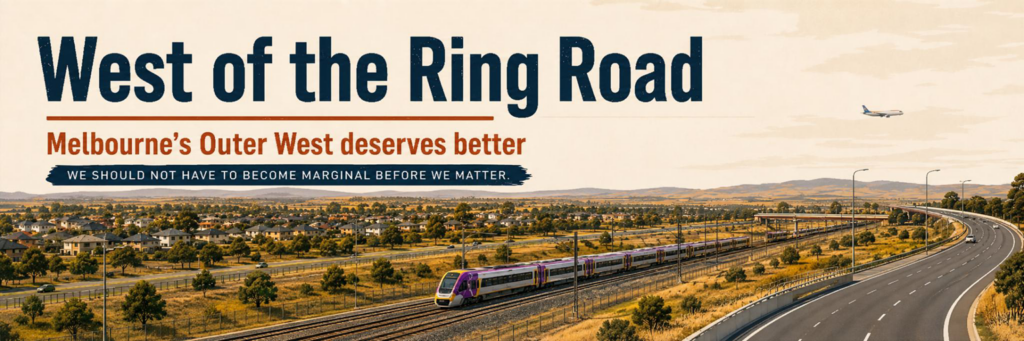
Melton should not have to reach breaking point before action is taken. We should not have to become marginal before we matter.
Sources
- Victorian Government, Major Construction Starts on New Melton Hospital, 16 April 2026.
- Victoria’s Big Build, Melton Level Crossing Removals.
- Victoria’s Big Build, Melton Line Upgrade.
- Victorian Government, Melton Electrification on the Way, 4 May 2026.
- Melton City Council, Victorian Budget: Council Welcomes Investment, but More Is Needed, 7 May 2026.
- Victorian Electoral Commission, Melton District.
- ABC News, Melton, Victorian Election 2018, updated 11 December 2018.
- Victorian Electoral Commission, Melton District Results, 2022 State Election.
Leave a Reply